Vietnam personal income tax for foreigners depends mainly on whether you are a Vietnamese tax resident, what income is taxable, and whether your employer can finalize for you. This 2026 guide explains rates, residency, withholding, deadlines, documents, and filing routes. It is general education; individual facts and current guidance can change the result.
Use the focused guides when you need a specific answer: Vietnam PIT withholding tax rates, Vietnam tax checklist for expats, Vietnam PIT declaration procedure, Vietnam PIT filing deadline, and Vietnam tax residency requirements.
Tax Finalization Overview
Tax finalization requires expatriates and cross-border workers in Vietnam to reconcile taxable income against the applicable law and guidance for the relevant income period.
🚀 Need assistance filing your return? Book our certified Vietnam PIT Finalization Service for Foreigners to claim your refund, reconcile multiple employers, and file error-free on eTax Mobile.
Is There a Tax Refund in Vietnam for Foreigners?
Foreigners who overpay PIT during monthly or quarterly withholdings are entitled to a tax refund or can offset the surplus against subsequent tax liabilities. To claim a cash refund, taxpayers must submit Form 02/QTT-TNCN along with withholding certificates (Chứng từ khấu trừ thuế TNCN) and specify their registered Vietnamese bank account.
Do Foreigners Pay Taxes in Vietnam?
Yes, foreigners working in Vietnam or earning Vietnam-sourced income are legally obligated to pay personal income tax. Tax residents are taxed on global income at progressive rates from 5% to 35%, while non-residents are subject to a flat withholding rate of 20% on Vietnam-sourced income without family deductions.
What is the Filing Deadline for Form 02/QTT-TNCN?
For individuals directly finalizing taxes with the tax authority, the statutory deadline is the last day of the 4th month following the end of the calendar year (April 30 or the first subsequent business day). Expatriates concluding their Vietnam employment contracts before year-end must finalize within 45 days prior to departing Vietnam under Decree 252/2026/ND-CP.
Quick Answers & Statutory Deadlines
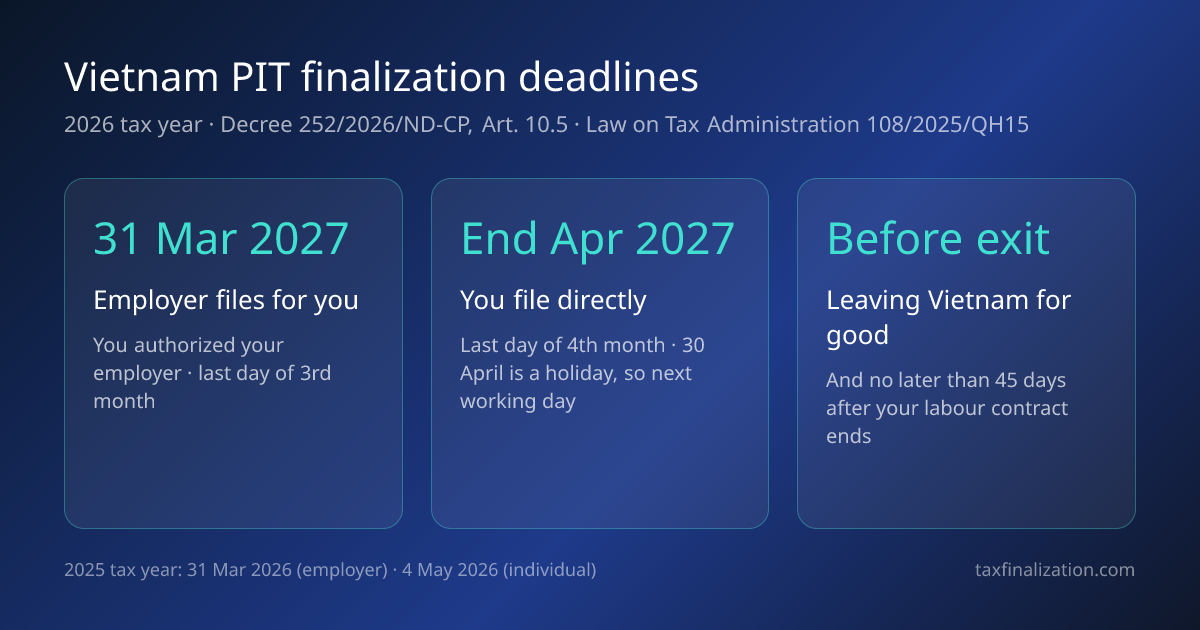
When is the Vietnam PIT finalization deadline? For the 2026 tax year, employers finalizing on behalf of employees must file by 31 March 2027 (the last day of the third month after year-end). Individuals filing directly have until the last day of April 2027, moved to the next working day because 30 April is a public holiday. These rules are in Article 10.5 of Decree 252/2026/ND-CP, which implements the new Law on Tax Administration 108/2025/QH15. For the 2025 tax year, the deadlines were 31 March 2026 and 4 May 2026.
Do foreigners have to finalize before leaving Vietnam? Yes. Since 1 July 2026, a resident foreigner whose labour contract in Vietnam ends must file the finalization return before exit, and no later than 45 days after the contract ends (Decree 252/2026/ND-CP, Article 10.5.d). The old option of leaving first and having an authorized party file within 45 days after exit (Circular 92/2015/TT-BTC) applied to departures before that date.
What changed in 2026? Under the new PIT Law 109/2025/QH15 and Resolution 110/2025/UBTVQH15 (in force 1 July 2026, with salary rules applying to the whole 2026 tax year), residents get a VND 15.5M monthly personal deduction, VND 6.2M per dependant, and a simpler five-bracket progressive scale from 5% to 35%.
Tax Residency Overview
Vietnam's PIT system treats you differently depending on whether you are a tax resident or a non-resident. That single determination decides your tax rates, which deductions you can claim, and whether you have to file an annual finalization at all.
You are a tax resident if:
- You are present in Vietnam for 183 days or more within a calendar year (1 January to 31 December), OR within any 12 consecutive months from your first arrival date; OR
- You have a regular residence in Vietnam: a registered permanent residence, or a rental lease covering 183 days or more in the tax year.
These tests are set out in Article 1 of Circular 111/2013/TT-BTC and carried forward in the 2025 PIT Law.
Non-residents pay a flat 20% on Vietnam-sourced employment income, with no deductions.
Practical tip: Arrival and departure days both count toward the 183 days. Keep a travel log and copies of your passport entry and exit stamps, because the tax authority checks them during finalization.
First-year arrivals: if you only become a resident under the 12-consecutive-month test, your first tax year runs for those 12 months rather than the calendar year. Under Decree 252/2026/ND-CP, Article 10.5.c, the first-year finalization is due by the last day of the fourth month after the month in which the 12-month period ends. Many expats who arrive mid-year get this wrong.
Who Must Finalize (and Who Can Let the Employer Do It)
Every tax resident with employment income has to finalize each year. If you had one employer all year, you can usually sign a form and let them file for you. If you changed jobs, worked for two companies at once, or were paid from abroad without Vietnamese tax being withheld, you file it yourself.
Option A: Authorize your employer
Under point d, clause 6, Article 8 of Decree 126/2020/ND-CP, you can authorize your employer to finalize for you if all of the following apply:
- You are a resident with salary or wage income
- You have a labour contract of 3 months or more with that employer
- You are still working there when the employer files its finalization, usually by 31 March
- Any other occasional income averages no more than VND 10M per month for the year, 10% has already been withheld on it, and you don't ask to finalize it
For the 2026 tax year, the new PIT rules raise that side-income limit to VND 15M per month. The other conditions stay the same.
You authorize the employer by signing Form 08/UQ-QTT-TNCN.
If you moved employers because of a merger, consolidation, or transfer within the same group, you can still authorize the new employer, and it will include the income paid by the old one.
Option B: File directly with the tax authority
You must finalize yourself if any of these apply:
- You worked for two or more employers in the year (and the side-income exception doesn't apply)
- You left your employer before it filed its finalization
- You had a contract of less than 3 months, or no labour contract at all (freelance, service, or probation arrangements)
- You received foreign-sourced income (for example, salary paid by an overseas parent company) that no Vietnamese employer withheld tax on
- You want to claim a refund of overpaid tax that the employer can't offset
Why this matters: Multi-employer cases are where most expats over-withhold. Each employer applies the progressive scale as if it were your only employer, so the combined withholding rarely matches what you actually owe. Read our multi-employer guide.
Who doesn't need to finalize
- Non-residents. Their 20% withholding is final.
- Residents whose additional tax payable after finalization is VND 50,000 or less (Decree 126/2020/ND-CP, point d.1, clause 6, Article 8, for the 2025 tax year)
- Note that under Decree 252/2026/ND-CP, an overpayment of VND 50,000 or less is not refunded. It is offset against your tax for the next period.
- Residents with no tax payable and no refund claim, who meet the conditions for their employer to finalize on their behalf.
Finalization Deadlines
If your employer files for you, the deadline is 31 March. If you file yourself, it is the last day of April, pushed to the next working day when that falls on a holiday. Leaving Vietnam changes the rule: you file before you exit, and within 45 days of your contract ending.
2026 tax year (filed in 2027)
| Who files | Statutory rule | Deadline |
|---|---|---|
| Employer (authorized by you) | Last day of the 3rd month after year-end (Art. 10.5.a) | 31 March 2027 |
| You, directly | Last day of the 4th month after year-end (Art. 10.5.c) | 30 April 2027, moved to the next working day because it's a public holiday |
| First-year resident under the 12-month test | Last day of the 4th month after the month the 12-month period ends (Art. 10.5.c) | Depends on your arrival date |
| Resident foreigner ending a labour contract | Before exit, no later than 45 days after the contract ends (Art. 10.5.d) | Before departure, and at most contract end + 45 days |
Legal basis: Article 10.5 of Decree 252/2026/ND-CP (30 June 2026), implementing the Law on Tax Administration 108/2025/QH15, both effective 1 July 2026.
2025 tax year (filed in 2026)
| Who files | Deadline |
|---|---|
| Employer (authorized by you) | 31 March 2026 |
| You, directly | 4 May 2026 (30 April and 1 May were public holidays) |
| Foreigner leaving before 1 July 2026 | Before exit, or an authorized party within 45 days after exit |
Legal basis: Article 44 of the Law on Tax Administration 38/2019/QH14; Article 21 of Circular 92/2015/TT-BTC.
Refund claims are not subject to the late-filing penalty, so you can still claim an overpayment after the deadline. Tax payable that you file late attracts penalties and interest (see [Penalties](#penalties)).
Forms, Documents & Where to File
Most people need one form, 02/QTT-TNCN, plus the 02-1/BK-QTT-TNCN appendix if they claim dependants. The rest is paperwork you mostly have already: a withholding certificate from each employer and a copy of your passport.
The forms
| Form | Purpose | Who uses it |
|---|---|---|
| 02/QTT-TNCN | Annual PIT finalization return | Individuals filing directly |
| 02-1/BK-QTT-TNCN | Appendix listing dependants claimed | Individuals claiming dependant deductions |
| 05/QTT-TNCN + 05-1/05-2/05-3 appendices | Employer's finalization return | Employers filing for staff |
| 08/UQ-QTT-TNCN | Authorization letter to employer | Employees choosing Option A |
These forms come from Circular 80/2021/TT-BTC and were used for the 2025 tax year. New implementing rules under Law 108/2025/QH15 may update form versions for 2026 filings, and the e-portal always serves the current version. The supporting documents are listed in Appendix I of Decree 126/2020/ND-CP.
Supporting documents checklist
- Tax withholding certificates from every employer (electronic certificates under Decree 70/2025/ND-CP from 2025)
- Passport and visa or temporary residence card pages
- Proof of foreign-sourced income and any tax paid abroad, if you're claiming a foreign tax credit
- Dependant registration documents: birth certificates, marriage certificate, and school enrolment letters for children over 18
- Charity receipts from registered organizations, if you're deducting donations
- For 2026 onward: VAT invoices for eligible healthcare and education expenses (see [Deductions](#deductions))
Use our interactive document checklist to build your personal list.
Where to file
If you file directly, the right tax office depends on your situation. It is one of:
- The tax office where you filed returns directly during the year
- The tax office of the employer that paid you the highest income
- The tax office that manages your income payer
- The tax office for your place of residence (for example, if no employer withheld tax)
How to File Online, Step by Step
Most expats now file electronically. The portal is canhan.gdt.gov.vn (the General Department of Taxation's individual e-portal), and the eTax Mobile app works for simple cases.
- Check your tax code and residency status. Log in with your tax code (MST) and confirm the registered details match your passport.
- Collect all withholding certificates. Missing one employer's certificate is the most common reason a return gets queried.
- Register dependants first. A dependant must be registered before you can claim them on Form 02-1/BK-QTT-TNCN.
- Choose the right tax office (see [Where to file](#forms-and-filing)).
- Complete Form 02/QTT-TNCN. Declare total income from all sources, compulsory insurance, deductions, and tax already withheld.
- Attach supporting documents as scanned files.
- Submit and keep the acknowledgement. The portal issues a receipt notice. Save it with your return.
- Pay any balance, or request a refund. Tax payable is due on the same day as the filing deadline. Refunds are paid to a Vietnamese bank account, so keep yours open until the refund arrives.
Refund timing: Straightforward "refund first, check later" cases are usually paid within a few working days. "Check first, refund later" cases can take up to 40 working days. First-time refunds and returns with discrepancies usually take the longer route.
2025 Tax Brackets (7-Bracket Progressive System)
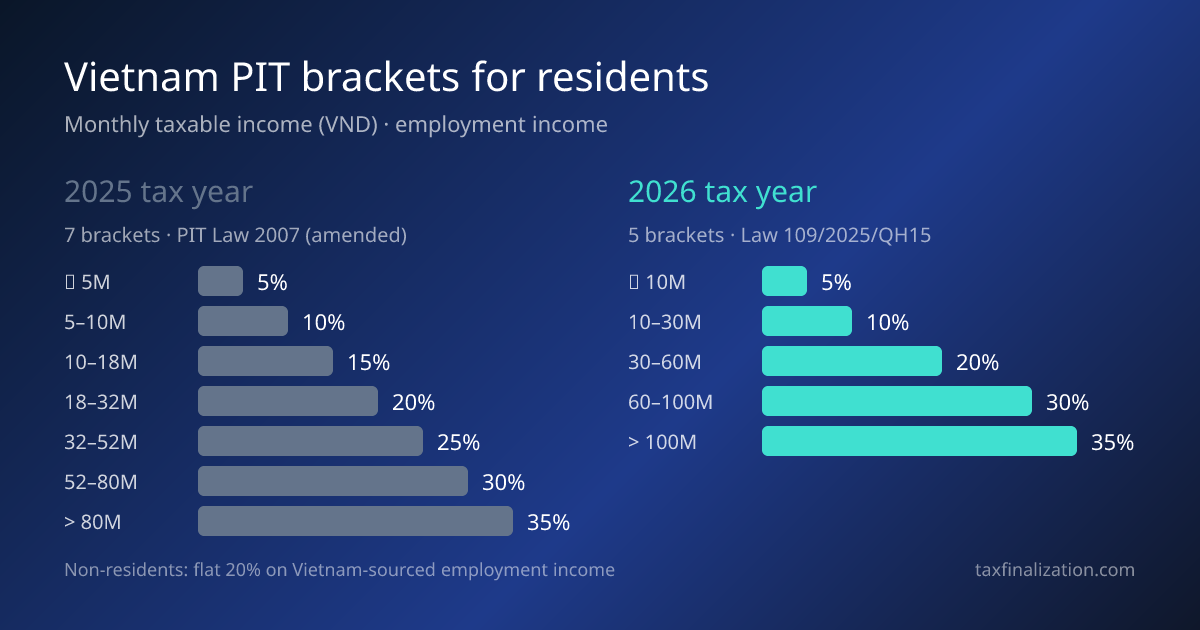
For employment income earned up to 31 December 2025, residents are taxed on this seven-bracket scale:
| Monthly Taxable Income (VND) | Annual Taxable Income (VND) | Rate |
|---|---|---|
| Up to 5,000,000 | Up to 60,000,000 | 5% |
| 5,000,001 – 10,000,000 | 60M – 120M | 10% |
| 10,000,001 – 18,000,000 | 120M – 216M | 15% |
| 18,000,001 – 32,000,000 | 216M – 384M | 20% |
| 32,000,001 – 52,000,000 | 384M – 624M | 25% |
| 52,000,001 – 80,000,000 | 624M – 960M | 30% |
| Over 80,000,000 | Over 960,000,000 | 35% |
Taxable income = Assessable income − Compulsory insurance − Personal deduction − Dependant deductions − Other allowable deductions
2026 Tax Brackets (New 5-Bracket System)
Most middle earners pay noticeably less tax in 2026. The scale drops from seven bands to five, and the 15% and 25% rates are gone.
The National Assembly passed PIT Law 109/2025/QH15 on 10 December 2025. It took effect on 1 July 2026, but its rules on employment income for residents apply to the entire 2026 tax year. The details are in Decree 253/2026/ND-CP and Circular 87/2026/TT-BTC.
| Monthly Taxable Income (VND) | Annual Taxable Income (VND) | Rate |
|---|---|---|
| Up to 10,000,000 | Up to 120,000,000 | 5% |
| 10,000,001 – 30,000,000 | 120M – 360M | 10% |
| 30,000,001 – 60,000,000 | 360M – 720M | 20% |
| 60,000,001 – 100,000,000 | 720M – 1,200M | 30% |
| Over 100,000,000 | Over 1,200,000,000 | 35% |
Key changes from 2025:
- Seven brackets become five, with much wider bands
- The 15% and 25% rates are gone. Middle incomes now fall into the 10% and 20% bands.
- The top 35% rate now starts at VND 100M per month instead of VND 80M
Impact example: A resident foreign employee earning VND 50M gross per month, with no dependants and insurance at the VND 46.8M cap in force until 30 June 2026:
- 2025 rules: taxable income VND 34,554,000, PIT VND 5,388,500/month
- 2026 rules: taxable income VND 30,054,000, PIT VND 2,510,800/month
- Saving: about VND 2.88M per month (VND 34.5M per year)
Because the new scale applies to the whole 2026 tax year, monthly withholding from January to June 2026 under the old scale will usually be too high. Your 2026 finalization (filed in 2027) is how you recover that difference.
Personal & Dependant Deductions
In 2026, before any tax is worked out, residents take VND 15.5 million a month off their income for themselves and VND 6.2 million for each registered dependant. Healthcare and tuition paid in Vietnam are now deductible too, up to yearly caps. Non-residents get none of these.
| Deduction | 2025 tax year | 2026 tax year |
|---|---|---|
| Personal (taxpayer) | VND 11,000,000/month | VND 15,500,000/month |
| Each qualifying dependant | VND 4,400,000/month | VND 6,200,000/month |
| Dependant income ceiling | VND 1,000,000/month | VND 3,000,000/month |
| Healthcare expenses | — | Up to VND 23M/year (new) |
| Education & training expenses | — | Up to VND 24M/year (new) |
When does PIT start in 2026? A resident pays no PIT until gross salary minus compulsory insurance exceeds the deductions. For a foreign employee contributing 9.5% (8% social insurance + 1.5% health insurance), that works out to about:
- Single, no dependants: VND 17.1M gross per month
- One dependant: VND 24.0M gross per month
- Two dependants: VND 30.8M gross per month
Who qualifies as a dependant?
- Children under 18
- Children over 18 who can't work, or who are in upper-secondary school, college, university or vocational training, and whose average income doesn't exceed VND 3M per month (2026)
- A spouse, parents, parents-in-law or other relatives you directly support, who meet the income and working-capacity conditions
Each dependant can be claimed by only one taxpayer per year, and must be registered with the tax authority before you claim them.
New healthcare and education deductions (2026): eligible medical costs at Vietnamese healthcare facilities (services on the health-insurance list) and tuition at Vietnamese education institutions, for yourself or your dependants. You need legally valid invoices in your name or your dependant's name, and anything reimbursed by insurance, your employer or anyone else can't be deducted again.
Also deductible:
- Your own compulsory social and health insurance contributions
- Donations to approved charitable, humanitarian or study-promotion funds (with receipts)
Non-Taxable Income & Benefits
Many common expat benefits are exempt or capped, but only with the right documentation:
| Benefit | Treatment |
|---|---|
| Home-leave airfare | Exempt: one round trip per year, paid by employer |
| Relocation allowance | Exempt: one-off allowance for relocating to Vietnam for work, if set out in the employer's policy or your contract |
| School fees for children (kindergarten to high school) | Exempt when paid by the employer |
| Housing provided by employer | Taxable, but the taxable amount is capped at 15% of other taxable employment income |
| Cash meal allowance | Exempt up to VND 1.2M/month from 1 July 2026 (previously VND 730,000). Meals provided directly or through vouchers are fully exempt. |
| Uniform allowance (cash) | Exempt up to VND 5M/year |
| Overtime and night-work pay | Fully exempt from the 2026 tax year (Decree 253/2026/ND-CP). Previously only the premium above normal pay was exempt. |
| Employer's compulsory insurance contributions | Not taxable to the employee |
| Business travel per diem | Exempt within the employer's financial policy |
| Hi-tech and strategic-technology specialists | 5-year PIT exemption on salary for qualifying roles (new under Law 109/2025/QH15) |
Withholding Changes in 2026
- 10% withholding threshold raised: employers paying someone without a labour contract, or on a contract of under 3 months, now withhold 10% only on payments of VND 5M or more (previously VND 2M).
- Side-income exemption from finalization: a resident whose other income averages no more than VND 15M per month, with 10% already withheld, doesn't have to include it in their finalization unless they choose to.
Non-Resident Rules
If you are in Vietnam for fewer than 183 days and have no regular residence:
- Employment income: flat 20% on income for work performed in Vietnam, wherever it is paid
- No deductions of any kind
- No annual finalization. The tax withheld is final.
Apportioning income: if you work both in Vietnam and overseas, your Vietnam-taxable income is calculated as:
- Physically present in Vietnam: worldwide employment income × (days in Vietnam ÷ 365), plus any benefits arising in Vietnam
- Not present but working for Vietnam: worldwide employment income × (Vietnam working days ÷ total working days), plus any benefits arising in Vietnam
Other non-resident rates:
- Dividends, interest and royalties: 5%
- Real estate transfers: 2% of the transfer price
- Listed securities transfers: 0.1% of the gross proceeds
- Prizes and inheritances: 10%
Leaving Vietnam: Departure Finalization
File before your flight, and no later than 45 days after your last contract day. When those two dates are months apart, the 45-day limit is the one that catches people out. Work out your exact deadline here.
If you are a resident foreigner ending your employment in Vietnam:
- Finalize before you exit, and within 45 days of your contract ending. This is the rule for departures from 1 July 2026 under Decree 252/2026/ND-CP, Article 10.5.d. The return covers income from 1 January to your departure date.
- Plan around your last working day, not your flight. If you stay in Vietnam more than 45 days after your contract ends, the 45-day limit comes first.
- Departures before 1 July 2026: under Circular 92/2015/TT-BTC you could leave first and authorize your employer or another party to file within 45 days after exit. If that applies to you and it hasn't been filed, talk to us.
- Settle any balance. Unpaid tax can lead to an exit ban under Decree 49/2025/ND-CP. The tax authority can ask immigration to stop you leaving if overdue tax exceeds the thresholds set in that decree.
- Keep a Vietnamese bank account open until any refund is paid, or give your authorized representative the power to receive it.
Common trap: leaving in, say, October and assuming next year's normal deadline applies. It doesn't. The departure rule replaces the annual deadline for that tax year, and the 45-day clock starts when your contract ends. See our full leaving-Vietnam checklist.
Double Taxation Agreements
Vietnam has signed DTAs with more than 80 countries, including the UK, France, Germany, Japan, South Korea, Australia, Singapore and most of ASEAN. A DTA can reduce or eliminate tax on income that both countries would otherwise tax.
Important: the USA has a signed treaty with Vietnam that is not yet in force. US expats rely on the Foreign Tax Credit (Form 1116) or the Foreign Earned Income Exclusion (Form 2555), and must file US returns every year regardless.
Claiming DTA relief:
- Get a Certificate of Tax Residency from your home country's tax authority for the relevant year
- Submit the DTA exemption or reduction notification with the certificate to your Vietnamese tax office
- Claim foreign tax credits in your Vietnamese finalization if you paid tax abroad on income that Vietnam also taxes. The credit is capped at the Vietnamese tax on that income.
DTA relief is never automatic. It needs documentation and timely notification.
Penalties, Interest & Exit Bans
| Issue | Consequence |
|---|---|
| Late filing (tax payable) | Administrative fine that rises with lateness, up to VND 15–25M for filings more than 90 days late (Decree 125/2020/ND-CP as amended by Decree 310/2025/ND-CP) |
| Late payment | Interest of 0.03% per day on the unpaid amount |
| Under-declaration | Fine of 20% of the under-declared tax, plus late-payment interest |
| Overdue tax above thresholds | Possible exit ban (Decree 49/2025/ND-CP) |
Refund-only returns filed late are not fined, but refund claims still expire after the statutory limitation period, so don't leave money on the table for years.
Real-World Examples
Example 1: Foreign Tax Resident, VND 60,000,000 Gross, 1 Dependant (2026)
| Step | Amount (VND) |
|---|---|
| Gross salary | 60,000,000 |
| Employee SI (8% × 50,600,000 cap) | −4,048,000 |
| Employee HI (1.5% × 50,600,000 cap) | −759,000 |
| Personal deduction | −15,500,000 |
| Dependant deduction (1 child) | −6,200,000 |
| Taxable income | 33,493,000 |
| PIT: 5% × 10M | 500,000 |
| PIT: 10% × 20M | 2,000,000 |
| PIT: 20% × 3,493,000 | 698,600 |
| Total PIT | 3,198,600 |
| Net salary | 51,994,400 |
The insurance cap is 20 × the statutory base salary. From 1 July 2026 the base salary is VND 2.53M (Decree 161/2026/ND-CP), giving a cap of VND 50.6M. It was VND 46.8M from 1 July 2024 to 30 June 2026. Foreign employees contribute 8% social insurance and 1.5% health insurance, and no unemployment insurance.
Example 2: Non-Resident, VND 60,000,000 Gross
| Step | Amount (VND) |
|---|---|
| Gross salary | 60,000,000 |
| PIT (20% flat) | −12,000,000 |
| Net salary | 48,000,000 |
At this income a non-resident pays nearly four times the resident's tax. Another reason to track your days carefully.
Example 3: Two Employers in One Year (2025)
An expat earns VND 40M/month from Employer A (January–June) and VND 45M/month from Employer B (July–December). Each employer withheld on its own payroll. Because the employee changed jobs and left Employer A, they can't authorize Employer B to cover the full year, so they must file Form 02/QTT-TNCN directly by 4 May 2026, combining both withholding certificates. Cases like this often end in a refund, because each employer applied the personal deduction only for its own months and withheld at a higher effective rate.
Common Mistakes to Avoid
- Assuming the employer handles everything. Authorization only works if you meet all the Decree 126 conditions (see [Who must finalize](#who-must-finalize)).
- Missing a withholding certificate from a previous employer. The tax office compares every certificate against your return.
- Claiming unregistered dependants. Register them first, and remember the 2026 income ceiling is VND 3M per month.
- Ignoring foreign-sourced income. Residents are taxed on worldwide employment income, including salary paid by an overseas parent company.
- Getting the departure deadline wrong. Since 1 July 2026, finalization is due before exit and within 45 days of your contract ending.
- Closing your Vietnamese bank account before your refund arrives.
- Not checking 2026 over-withholding. January–June 2026 payroll may have used the old scale.
🚀 Need professional assistance? Let our licensed tax specialists handle your Vietnam PIT finalization dossier to ensure 100% statutory compliance, claim your maximum refund, and file error-free on eTax Mobile.
Sources: PIT Law 109/2025/QH15; Decree 253/2026/ND-CP; Circular 87/2026/TT-BTC; Law on Tax Administration 108/2025/QH15 and Decree 252/2026/ND-CP (Art. 10.5); Law on Tax Administration 38/2019/QH14 (Art. 44); Decree 125/2020/ND-CP as amended by Decree 310/2025/ND-CP; Decree 126/2020/ND-CP (Art. 8.6.d, Appendix I); Circular 80/2021/TT-BTC; Circular 111/2013/TT-BTC (Art. 1) as amended by Circular 92/2015/TT-BTC (Art. 21); Decree 49/2025/ND-CP. Official texts: vbpl.vn, gdt.gov.vn and the e-portal canhan.gdt.gov.vn. This guide is general information, not tax advice for your specific situation.